

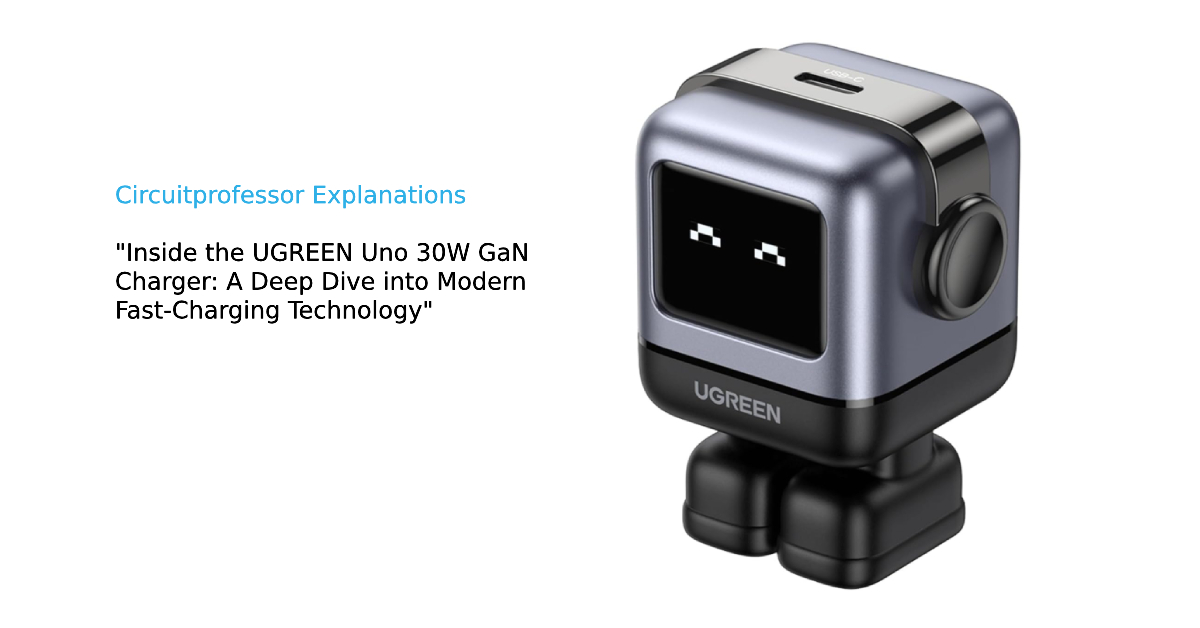
The UGREEN Uno 30W USB-C charger represents a significant leap in charging technology, combining gallium nitride semiconductors with intelligent power delivery protocols in a compact, robot-themed design. This charger delivers 30W of power through a single USB-C port, capable of charging an iPhone 14 Pro Max from 0% to 55% in just 30 minutes. The device measures significantly smaller than traditional silicon-based chargers while providing the same power output, achieved through advanced semiconductor physics and circuit design.
The Semiconductor Revolution: Why Gallium Nitride Changes Everything
Material Physics and Bandgap Energy
Gallium nitride operates on fundamentally different physical principles compared to traditional silicon semiconductors. The critical difference lies in the bandgap energy the amount of energy required to free an electron from its atomic orbit and allow it to conduct electricity through the material. Silicon possesses a bandgap of 1.1 electronvolts (eV), while gallium nitride exhibits a bandgap of 3.4 eV more than three times higher. This wider bandgap enables GaN to withstand electric fields approximately 3.3 megavolts per centimeter before electrical breakdown occurs, compared to silicon’s theoretical limit of around 20 volts per micrometer.
The bandgap determines how much voltage the material can handle before electrons break free uncontrollably. In practical terms, a 650V GaN transistor can support over 800V in a drain drift region measuring only 10-20 micrometers, achieving a breakdown strength of 40-80 volts per micrometer. This allows the UGREEN charger to safely handle voltage conversions from 100-240V AC input down to various DC output voltages (5V, 9V, 12V, 15V, and 20V) within a much smaller physical space.
Electron Mobility and Switching Speed
The speed at which electrons move through a semiconductor material directly determines how quickly the transistor can switch on and off. Gallium nitride demonstrates electron mobility between 1,000-2,000 cm²/V·s, approximately 30% faster than silicon’s mobility. Additionally, GaN exhibits an electron saturation velocity of 2.5×10⁷ centimeters per second, enabling rapid charge carrier movement through the crystal lattice.
These mobility characteristics translate to switching transition times of only 1-2 nanoseconds for GaN transistors, compared to 20-50 nanoseconds required by silicon and silicon carbide transistors. During the transition period when a transistor is neither fully on nor fully off, power dissipates as heat, wasting energy. The faster the switching speed, the less time spent in transition, and the less energy lost as heat. GaN transistors in the UGREEN charger can operate at switching frequencies between 100 kHz and several megahertz, enabling the use of smaller magnetic components like transformers and inductors.
Thermal Management and High-Temperature Operation
Gallium nitride’s thermal conductivity ranges between 130-230 watts per meter-kelvin, allowing efficient heat dissipation from active junctions. The material maintains stable electrical performance at junction temperatures up to 250°C, significantly higher than silicon’s maximum operating temperature. UGREEN Uno 30W incorporates a “Thermal Guard” system that leverages these properties, along with built-in protection against overheating, short circuits, overload, and overvoltage.
The hexagonal crystal structure of gallium nitride contributes to its thermal stability. When gallium (atomic number 31) combines with nitrogen (atomic number 7), the resulting compound exhibits a melting point exceeding 1,600°C 200°C higher than silicon’s melting point. This robust thermal characteristic allows the charger to maintain efficiency even during continuous high-power operation without requiring large heat sinks or cooling fans.
USB Power Delivery: The Intelligence Behind Fast Charging
Protocol Negotiation and Voltage Selection
USB Power Delivery operates as a bidirectional communication protocol that allows the charger and device to negotiate optimal power levels. The UGREEN Uno 30W supports multiple PD voltage profiles: 5V at 3A (15W), 9V at 3A (27W), 12V at 2.5A (30W), 15V at 2A (30W), and 20V at 1.5A (30W). This negotiation occurs through the USB-C cable’s CC1 and CC2 pins, which carry digital communication signals between the charger and device.
The Power Delivery protocol dynamically switches between fixed voltage levels to match the device’s battery requirements. PD 3.0, the version implemented in this UGREEN Uno 30W, supports power delivery from 5W up to 100W through voltage options of 5V, 9V, 15V, and 20V. The protocol includes fast fault detection mechanisms that monitor voltage and current in real-time, disconnecting power within microseconds if abnormal conditions occur.
Programmable Power Supply (PPS) Integration
Programmable Power Supply represents an advanced extension of USB PD 3.0 that enables fine-grained voltage control. Instead of selecting from fixed voltage steps, PPS allows voltage adjustments in increments of 20 millivolts and current adjustments of 50 milliamps every 10 seconds. This precise control reduces energy conversion losses inside the receiving device’s battery charging circuit.
The real-time voltage adjustment capability of PPS directly addresses thermal efficiency. By matching the charger output voltage closely to the battery’s instantaneous voltage requirement, the voltage regulator inside the device converts less energy to heat. According to USB Implementers Forum data, PPS reduces charging temperatures by over 5°C compared to fixed-voltage charging and improves battery longevity through reduced thermal stress. The UGREEN charger negotiates PPS parameters continuously, optimizing power transfer throughout the entire charging cycle from 0% to 100% battery capacity.
Multi-Protocol Compatibility
Beyond USB PD, the charger supports Quick Charge protocols for compatibility with older devices. Quick Charge 3.0 implements voltage regulation in 200mV steps, while Quick Charge 4.0 provides 20mV step regulation with 50mA current adjustment effectively incorporating PPS functionality. This backward compatibility ensures the UGREEN Uno 30W works with devices from multiple manufacturers, including iPhones (which use USB PD), Samsung Galaxy phones (PD and PPS), Google Pixels (PD and PPS), and various tablets and laptops.
The charger’s protocol detection occurs within milliseconds of cable connection. The USB PD controller identifies the connected device through its advertised capabilities, then selects the highest mutually-supported protocol. If the device doesn’t support fast charging, the charger defaults to standard 5V USB operation, ensuring universal compatibility across all USB-powered devices.
Power Conversion Circuit Architecture
Buck Converter Topology and Operation
The UGREEN Uno 30W employs a buck converter (step-down converter) topology to transform high input voltage to lower output voltages. The basic buck converter consists of four primary components working in sequence: an input switching transistor, a freewheeling diode (or synchronous rectification transistor), an inductor for energy storage, and an output capacitor for voltage smoothing.
The operation cycle occurs in two phases. During the first phase, the high-side GaN transistor switches on, connecting the input voltage to the inductor, which stores energy in its magnetic field while current flows to the output. During the second phase, the high-side transistor switches off, and the low-side transistor switches on, allowing the inductor to release its stored energy to maintain output current. The ratio of on-time to total cycle time determines the output voltage a concept called duty cycle modulation.
Synchronous rectification replaces traditional diodes with active transistors, significantly reducing power loss. The GaN transistors in the UGREEN Uno 30W exhibit on-resistance (RDS(on)) values as low as 22-26 milliohms, resulting in minimal conduction losses and efficiency reaching 98% in optimal conditions. This high efficiency translates to less heat generation the charger’s case temperature rises only approximately 40°C during continuous 30W operation.
Switching Frequency and Component Miniaturization
The switching frequency directly determines the size of passive components in the power supply. Traditional silicon-based chargers operate at frequencies between 65-100 kHz, requiring large inductors and capacitors to smooth the output voltage. GaN transistors enable switching frequencies exceeding 1 MHz ten times faster than silicon designs.
Higher switching frequency allows dramatic size reduction in magnetic components. The energy stored in an inductor during each switching cycle equals 0.5 × L × I², where L represents inductance and I represents current. When switching frequency doubles, the same power transfer requires only half the inductance value, resulting in a physically smaller inductor. The UGREEN Uno 30W leverages switching frequencies in the hundreds of kilohertz to low megahertz range, enabling the compact form factor while maintaining output power capacity.
The absence of reverse recovery charge in GaN High Electron Mobility Transistors (HEMTs) eliminates hard commutation failures that plague silicon MOSFETs at high frequencies. Silicon diodes require time to stop conducting when reverse voltage applies a phenomenon called reverse recovery. During this recovery time, both transistors momentarily conduct simultaneously, creating a short-circuit condition and wasting energy. GaN HEMTs completely eliminate this effect, maintaining high efficiency even as switching frequency increases beyond 200 kHz.
Electromagnetic Interference (EMI) Management
High-frequency switching generates electromagnetic interference that can affect other electronic devices. The UGREEN Uno 30W addresses EMI through multiple strategies. First, the integrated GaN power IC design minimizes parasitic inductance and capacitance by placing the gate driver circuit on the same die as the power transistor. This eliminates the discrete wire connections between chips that act as antennas radiating electromagnetic energy.
Second, the circuit layout employs short, low-inductance routing with strong grounding to reduce EMI generation. The voltage transitions (dV/dt) and current transitions (dI/dt) during switching create electromagnetic fields proportional to their rate of change. By controlling the gate drive characteristics, the charger can moderate these transition rates, balancing switching speed with EMI compliance. Third, the design incorporates EMI filter components typically common-mode chokes and X/Y capacitors that attenuate high-frequency noise before it propagates through the power cord.
Mechanical Design and User Interface
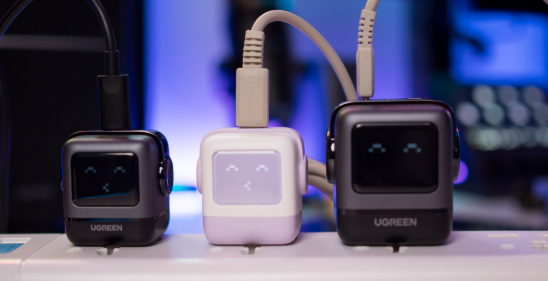
The charger features a distinctive robot-themed enclosure with an LED display face. The LED matrix shows animated expressions during charging and displays a specific pattern when devices reach full charge, providing visual feedback without requiring the user to check their device screen. The compact housing measures significantly smaller than equivalent silicon chargers, achieved through the combination of GaN’s high power density and high-frequency operation enabling smaller passive components.
The single USB-C port configuration supports universal compatibility with modern devices. The port provides both power delivery output and communication through the CC pins. The charger accepts input voltages from 100-240V AC at 50/60 Hz, making it suitable for use worldwide without voltage converters. The foldable or fixed prongs (depending on market) integrate directly into the housing, eliminating the need for separate cables between wall outlet and charger body.
The UGREEN Uno 30W GaN charger exemplifies how advances in semiconductor physics, intelligent power protocols, and circuit topology engineering converge to create smaller, faster, and more efficient charging solutions. The 3.4 eV bandgap of gallium nitride enables high-voltage operation in compact transistors, while electron mobility of 2,000 cm²/V·s supports switching speeds up to 100 times faster than silicon. USB Power Delivery with PPS negotiates optimal voltage and current in real-time, reducing conversion losses and thermal stress. The buck converter topology, operating at megahertz frequencies, delivers 30W of power through miniaturized magnetic components achieving 98% efficiency. These technologies combine to deliver practical benefits: charging speeds three times faster than traditional chargers, in a package half the size and weight, with reliable thermal management for continuous operation.
More product analysis – https://circuitprofessor.com/category/product-analysis/